
About ITX

BEYOND SHARED SERVICES
Why many leading organizations set-up their own
Global Employment Company to manage Global Mobility
Synopsis
Global Mobility is an enabler of organizational growth and can deliver competitive advantage to organizations by hiring and deploying the best resources across borders as needed. Nevertheless, Global Mobility is a complex area, requiring a wide range of competencies. In many organizations, transactional processes are managed by Shared Service Centers, whereas the more strategic aspects of Global Mobility are managed by Centers of Expertise (COEs) that provide expert advice and guidance to business units. This model delivers many benefits, but it also has some limitations. In fact, some of the world’s leading international organizations have gone one step further and implemented their own Global Employment Company (GEC), which offers all the benefits of Shared Services and COEs, plus a few more. In this article we explore the key concept of a GEC, and how it creates value beyond what most Shared Services and COEs combined can deliver.
The strategic importance of Global Mobility
In today’s globalized business environment, many organizations operate and compete across borders. Having the right talent is the key to competitive advantage. As many manual tasks become automated, the shelf-life of manual skills is becoming shorter, whereas having talent with the best knowledge, experience, innovation and leadership skills represent the real competitive differentiator for most organizations.
As a result, today’s competition is not only for customers, but also for the best talent. Being able to hire and deploy talent across borders quickly and efficiently becomes, therefore, a critical element of the competitive strategy and operating model of today’s most successful organizations.
In this context, the Global Mobility function plays a key role in enabling the organization to deliver the right skills wherever the business requires them. This is no easy task. In fact, Global Mobility remains one of the most complex areas of Human Capital Management.
The value of Shared Services and COEs in Global Mobility
International Assignments can be both expensive and risky. The costs are mainly associated with the additional compensation required for relocation, housing, children’s education, home leave, tax equalization, cost of living adjustments, international medical insurance, tax and immigration consulting services, and various others. There are also potential indirect costs resulting from delayed deployments, penalties and interests for non-compliance, Corporate Tax exposure, and more.
On the risk side, many of these derive from complex compliance obligations arising in multiple jurisdictions, in terms of Tax, Social Security, Immigration, Employment Law, reporting requirements, and various others. In the Global Mobility world, compliance obligations often apply simultaneously in multiple locations, therefore it is not sufficient to be familiar with the requirements of one country, but it is necessary to understand how all these obligations interact with each other. For example, a US national living in the United Kingdom and being deployed to Thailand could potentially create a tax liability in all 3 jurisdictions.
Secondary risks factors include the health and safety of the employee and accompanying family during the assignment and, not least, the risk of a premature repatriation or resignation, which would represent the loss of talent, opportunity costs, project delays, and loss of the money invested in the initial deployment.
Since even small mistakes can be risky and costly, organizations cannot afford to have a dysfunctional Global Mobility framework. Policies and processes must be carefully designed, accurately executed, and constantly aligned to the organization’s strategies and priorities.
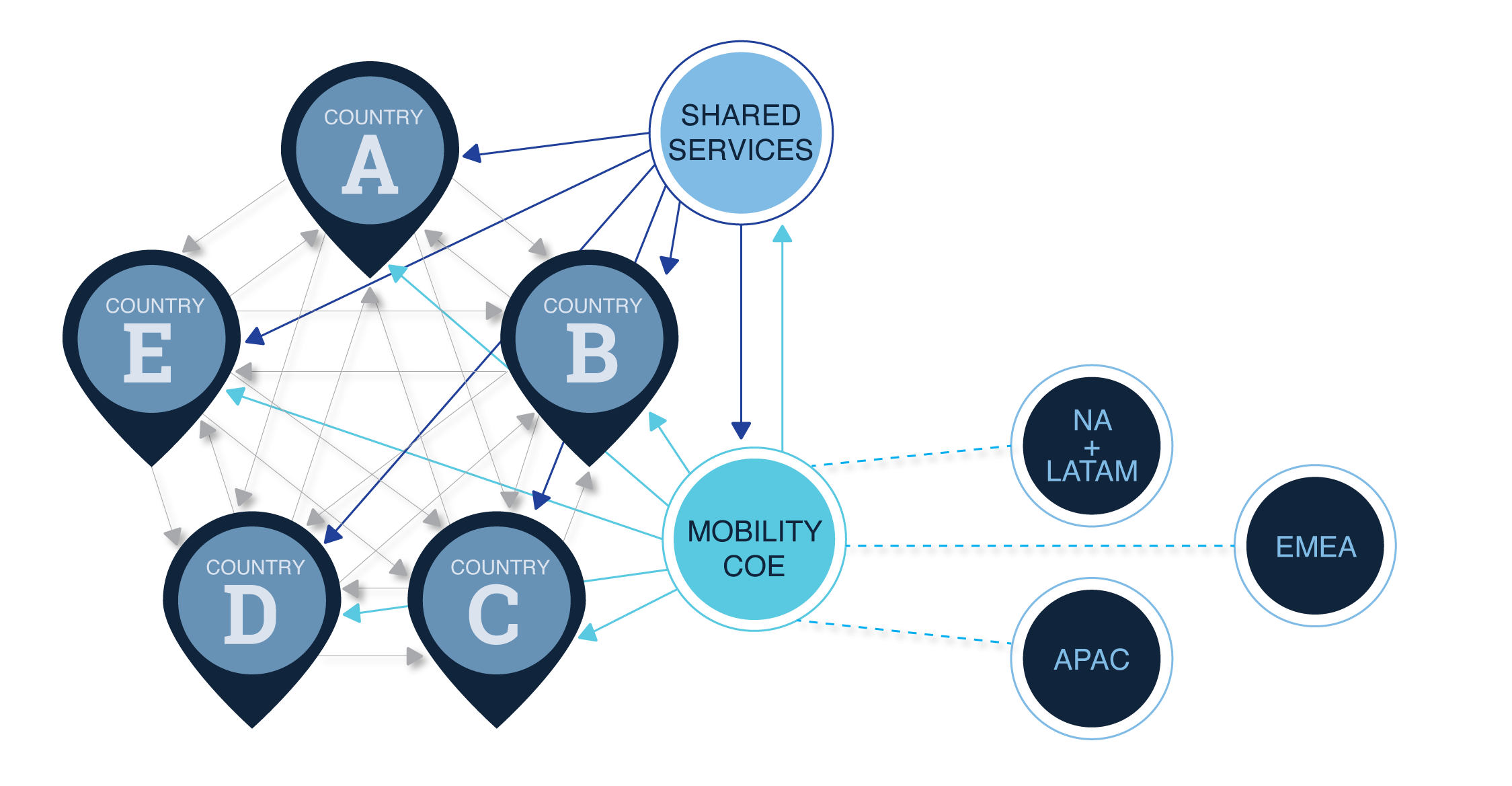
At the same time, it is often not feasible to have the appropriate level of Mobility resources and experience in every location that either sends or receives an international assignee. To achieve better efficiency, many of the world’s leading organizations chose to centralize at least part of these processes and infrastructure into Shared Service Centers, which focus on transactional tasks, coupled with Centers of Expertise (COEs), namely Global Mobility teams, who deliver advice to the assignees and Business Units, and primarily focus on the design, governance, strategic alignment and continuous improvement of the mobility programs.
This centralization reduces the duplication of efforts and resources, delivers consistent standards of support and advice to the entire organization, helps to rationalize the investment in infrastructure, such as real estate and technology tools and, in the case of Shared Services, it often delivers savings by relocating processes to cost effective locations. In essence, the Shared Service Center aims to absorb as much as possible of the administrative burden, to release bandwidth in the other HR teams, allowing them to focus on more strategic and value-added tasks. The model described above can be found in many organizations and, generally, it manages to deliver most of the above-mentioned objectives. However, it is important to understand the limits of such a model and explore an alternative that has been adopted by many leading organizations over for many years, namely the Global Employment Company (GEC) model.
Limitations of Shared Services + COE model
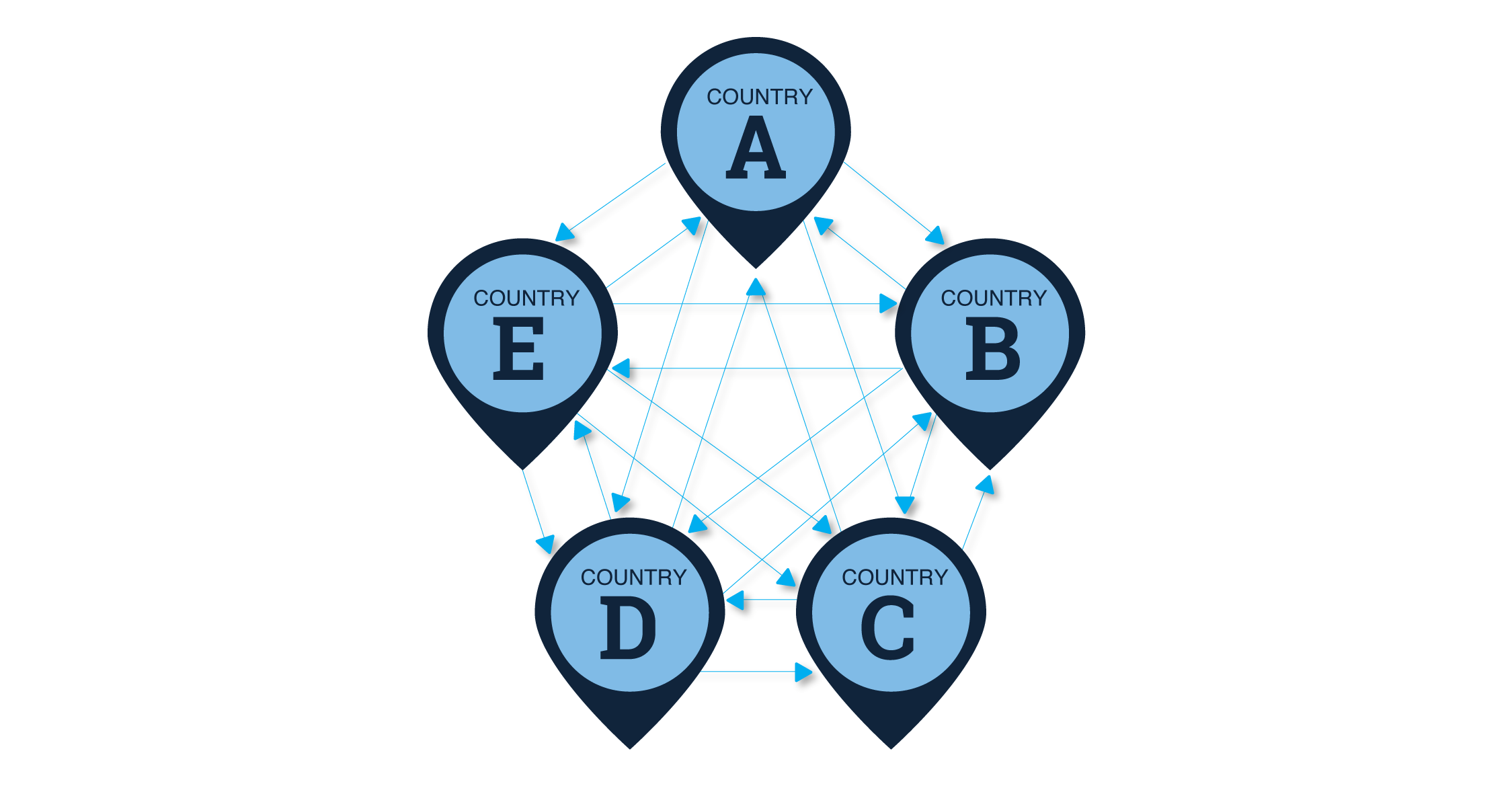
Much of the complexity of Global Mobility is linked to the potentially huge number of combinations of “home” and “host” countries. To be mathematically precise, we should use the term “permutations” rather than “combinations”, since the direction of travel makes a difference. For example, the administrative, compliance and compensation arrangements for a German employee moving to Malaysia will be totally different from the arrangements needed for a Malaysian employee moving to Germany. In an organization operating in 10 countries there are 90 possible permutations. In an organization operating in 20 countries, the number of possible permutations goes up to 380. Fortunately, most organizations tend to have fewer home-host permutations, but the fact remains that complexities can escalate very quickly indeed.
In such a traditional “home-host” model, the assignees are employed by a “home country” and deployed to a “host country” using the applicable mobility policy. There are several challenges with such a model:
(a) Each group of employees is employed by a different country, hence on different terms and conditions.
(b) If the policies and processes require employees to be paid through the home country’s payroll, it becomes harder to build a holistic picture of how much the organization is spending on Global Mobility programs. Each location will have part of the total information, which would need to be consolidated in a separate process step.
(c) Internal re-billing of costs can be potentially very complex, as each country may need to invoice multiple countries, and also deal with incoming internal invoices.
(d) Depending on the combination of home and host countries, the employee may or may not be able to benefit from Social Security Totalization Agreements, allowing the employee to continue the contribution in his/her home country during the assignment.
(e) Each of the “home” legal entities could potentially trigger a Corporate Tax liability in each host location where the employee is deployed (a tax construct known as Permanent Establishment, or PE). This will depend on a variety of factors, and not every assignment will trigger a PE risk. Nevertheless, the sheer number of possible home-host permutations increases the potential PE exposure and makes the monitoring and mitigation of such risk extremely complex.
(f) Despite the existence of a Shared Service Center and a Mobility COE, inevitably the HR teams in each home and host country would need to be involved in the process to some degree. However, not every location will have the right level of experience to manage the process efficiently. Typically, quite a lot of coordination and guidance may be required.
(g) Information and data would need to be exchanged between home country, host country, COE, and Shared Services team, with a great likelihood of data duplication, unless the information exchange is supported by technology tools that are consistently and accurately used by all stakeholders in the process.
(h) Due to the number of stakeholders involved in the process (Home HR, Host HR, COE, Shared Services), the processes will be “fragmented”, meaning that each team will be responsible for part of the process. This is one of the most common frustrations experienced by assignees and managers, who need to interact with multiple teams as they navigate the process from start to finish.
(i) As the number of possible home-host permutation increases, the need for additional data, such as Cost of Living Allowances, may also increase.
(j) The model is generally less agile, due to the greater need for coordination. Therefore, it is typically harder for the COE to ensure governance and consistency, or to introduce changes in policies, processes, forms, templates or technology tools. The lag-time between strategy and execution becomes much longer, due to the need for communication and implementation across multiple locations.
(k) Since it is harder to achieve a holistic view of all aspects of the Mobility programs, and to receive accurate and timely information, it is usually more challenging for the COE to make decisions and recommendations on how to continuously improve the mobility programs.
In addition to the above considerations, it is also worth considering that the COE + Shared Services model also requires coordination between these two. Usually, Shared Service Centers and COEs are not co-located, hence a lot of communication is required. In many organizations, the COE itself is geographically distributed, often with regional hubs. This decentralization creates further “process fragmentation” and requires additional communication, coordination and, ideally, technology enablement. The geographic and structural separation between COE and Shared Services could result in delays in keeping the two aligned. In practice, this means that the COE may not have full, immediate and direct visibility of how the Shared Services team is performing, and it may take some time before the COE team realizes that something can be improved.
The Global Employment Company (GEC) – What it is, and why many leading organizations use it
GECs are not new, and have been used by many organizations for decades. Nevertheless, many HR professionals remain either unfamiliar with, or confused by the concept. In a nutshell, a GEC is a wholly-owned subsidiary of a group or, alternatively, a branch of one of its subsidiaries, which becomes the legal employer of mobile employees prior to their deployment. It is important to understand that that the GEC is not a third-party provider, therefore the employees remain employed by the same organization, albeit a different legal entity.
GECs are very versatile structures, which can be used in a variety of ways, provided that all the compliance requirements are observed. In principle, GECs can be used to support all long-term international assignments, including “global nomads”, i.e. assignees who spend a considerable part of their career away from their home country, and/or to act as the employing entity for employees hired on fixed-term contracts for specific overseas projects. Some organizations also host their top executives in a GEC, for confidentiality reasons and, in specific cases, GECs could also be used to support some Remote Employees. In terms of internal procedures, the GEC typically bears the cost of the assignees and re-charges this cost to the appropriate Cost Center in the host location, plus a Management Fee based on Transfer Pricing rules, all based on an internal Service Agreement.
Under a GEC model, the number of home- host permutations is significantly reduced, since all assignees are deployed from the same legal entity. Therefore, there is only one legal entity that could potentially trigger a Permanent Establishment exposure in overseas locations, which makes it a lot easier to monitor and mitigate the risks, especially since the GEC is often a centralized function, integrating the COE and the Shared Services.
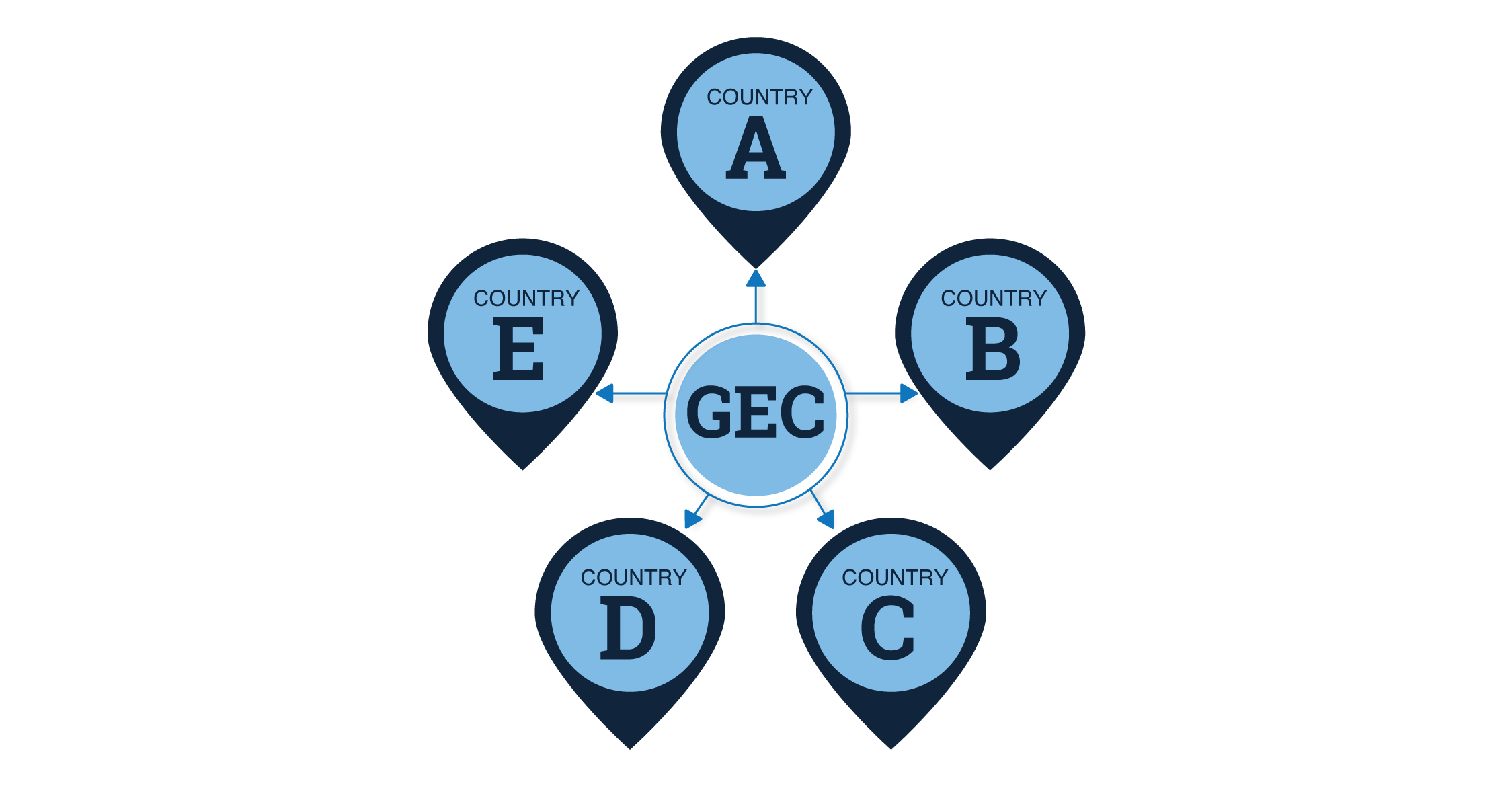
In fact, since the GEC is both the employing entity and the home country, as well as the COE and the Shared Service Center, it will enjoy much better governance, control and holistic visibility of every aspect of the Global Mobility programs, leading to better analysis and decision-making. From an operational standpoint, policies and processes are interpreted and implemented consistently and correctly, with less involvement from individual home locations.
Furthermore, consolidation of all the assignee headcount in a single entity makes it easier to introduce a single international payroll. This, in turn, makes it easier to build a global picture of the overall mobility spend, and it greatly streamlines the internal re-billing of the costs to the relevant cost centers.Management reports become more accurate and easier to produce, especially if an adequate technology tool is in place, integrating payroll, expenses management and invoicing. The aggregation of the headcount into a single entity also creates economies of scale and critical mass which is useful when designing and negotiating some benefit plans, such as International Retirement Plans or Global Medical Plans. Depending on its design, the GEC can also provide better harmonization of terms and conditions between assignees of different nationalities, especially those who are in highly mobile roles. In addition, if the GEC is established in specific countries, for example Switzerland, it is possible for all GEC assignees to leverage existing bilateral Social Security agreements under certain conditions, regardless of nationality.
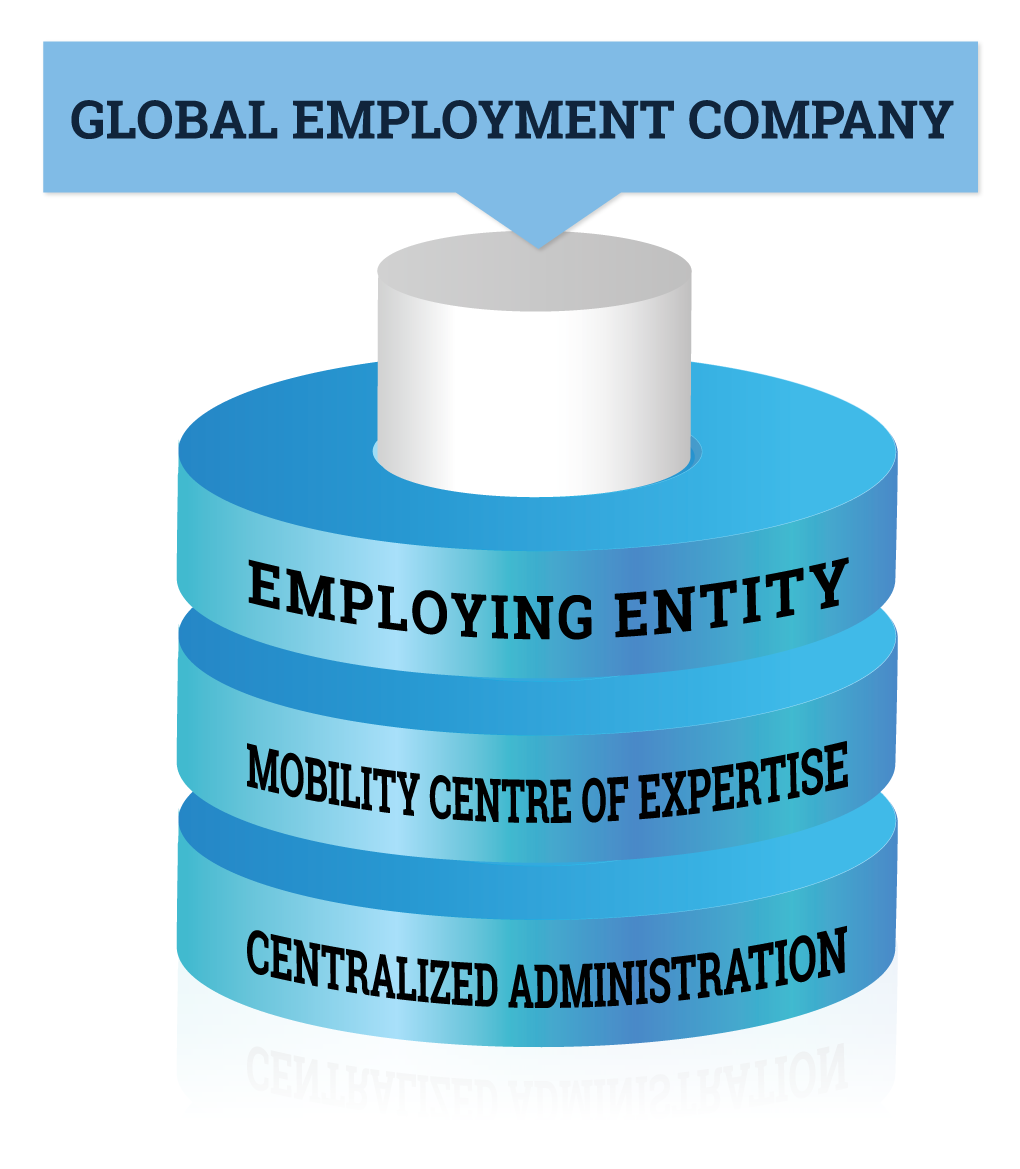
In summary, organizations that have a global employment company enjoy a greater simplification of their Mobility programs. Managers and assignees have a clear point of coordination and accountability for the entire end-to-end process. The GEC has full visibility of every aspect of the Mobility Program, as well as each individual case. Ultimately, this delivers better support, faster deployment timelines, better governance and compliance, enhanced risk mitigation, and more effective cost management.
The key differences
between a Shared Service Centre and a GEC
Shared Services
GEC
Is a legal entity or a branch employing the assignees
Facilitate the payroll, expenses management and internal re-billing
from a single entity
Can aggregate headcount into a single entity, creating critical mass and potential volume discounts on benefits
Helps to reduce the number of home-host permutations
Helps to mitigate Permanent Establishment risk
Can be established in a location that benefits the assignees and/or the
business in terms of Employment Law, Social Security agreements, etc.
Could potentially act as the employing entity for fixed-term contract
employees and/or some Remote Employees
Provides centralization of administrative processes and technology
infrastructure
Can act as the COE for Global Mobility
No
No
No
No
No
No
No
No
No
No
Yes
Maybe
Yes
Yes
Yes
Yes
Yes
Yes
Yes
Yes
Yes
Yes
Yes
Yes
As we ponder on the key differences between a Shared Service Center and a GEC, it is worth pointing out that it is often difficult to convert a Shared Service Center into a GEC. This is because the location of the GEC needs to be very carefully selected, and many Shared Service Centers are unlikely to be in locations suitable for GECs. In addition, the skills and competencies typically found in Shared Services are only a subset of what a GEC would need. Nevertheless, Shared Services and GECs are not mutually exclusive, and it is perfectly possible to have both within the same organization. However, it is important to ensure that the processes do not become unnecessarily fragmented and that the assignees and managers have a clear Case Manager for each assignment.
The transition to a GEC model needs to be evaluated and managed carefully, since it represents a major undertaking. The initiative needs to be subject to a detailed Feasibility Study and discussed amongst various stakeholders at senior level. The GEC needs to be carefully designed, clearly communicated in terms of its purpose and operating model, as well as the impact that it will have on employees and managers, and the role that the various stakeholders will need to play in its operations. Following the design, the set-up of the GEC needs to be carefully and expertly project managed, and once the GEC is ready to “go live”, it needs to operate impeccably, to deliver the expected benefits.
Which companies are good candidates
for a GEC model?
In general, companies may decide to set up a GEC for different reasons, for example better governance and compliance, simplification and standardization of processes, expert and efficient execution, cost considerations, for confidentiality purposes, or all of the above. It is a common misconception that GECs are only suitable for organizations with a large number of expatriates deployed around the world. While it is true that such organizations would almost definitely benefit from a GEC model, these benefits can be enjoyed by a much broader range of companies. A recent survey conducted by ITX, the world's leading expert in Global Employment Companies (www.itx- ge.com), revealed that GECs can be found in all industries as represented by some of the world's leading companies in Oil & Gas, Mining, Engineering, Life Sciences, Chemical, Automotive, Manufacturing, Financial Services, Food & Beverage, and many other sectors. With regard to the size of the expatriate population, the profile is equally diverse.
At one end of the spectrum there are organizations that use the GEC to employ a few thousand expatriates, and at the opposite end of the spectrum it is possible to find organizations that use a GEC to host very few employees. So, is there a minimum number of employees required to justify having a GEC? The answer depends on the objectives for considering the GEC model. For example, if the main driver for considering a GEC is efficiency, economies of scale, and cost containment, then a GEC model makes sense provided there is a significant volume of cross-border assignments to be managed. On the other hand, if the GEC is expected to deliver other benefits, for example confidentiality, then it may be perfectly justifiable creating a separate entity for a relatively small number of employees, such as Senior Executives.
Why some of the world’s leading organizations decide to outsource the GEC’s operations?
All the activities related to the feasibility assessment, design, implementation and operation of the GEC require a significant amount of specialist expertise. It is possible, and indeed common and highly recommended, to engage external advisors to provide support and guidance. Once the decision is made to implement a GEC, the implementation costs and timelines depend on the chosen approach. Typically, an implementation done entirely in-house is likely to require more time and capital investment, compared to a co-sourced or outsourced model. Outsourcing the implementation and operation of the GEC can significantly reduce the cost and implementation timelines leading to the “go live” date. This is because the service provider will typically have all the necessary resources, technology, and skills readily available in the right location.
By contrast, an in-house implementation would entail a much longer and cumbersome journey in terms of identifying, deploying, and training internal resources, and making significant complex decisions regarding technology tools, which will need to be approved, selected, procured, configured, tested, and ultimately operated by resources who will need training and support in order to achieve the required levels of efficiency. In this respect an outsourced or co-sourced GEC solution would enable most organizations to enjoy the benefits of the GEC model within a shorter timeframe, without excluding the possibility that at a later stage the ongoing operations of the GEC could be brought back in house. In terms of the ongoing operation of the GEC, in-house models will have several “fixed costs”, in terms of headcount, real estate and IT infrastructure, not to mention management time. The ROI for this investment (i.e. the service quality) is highly dependent on keeping staff turnover low and ensuring that the team remains constantly up to date with changes in immigration, tax, social security and employment laws in all applicable jurisdictions. Furthermore, business continuity depends on this team having access to the premises, tools and information required to perform their job. By contrast, an outsourced GEC would continue to be wholly-owned by the same organization, but operated by highly skilled specialist provider, with no need to invest heavily in resources, technology or real estate.
Thanks to the combination of centralization and outsourcing, some organizations are leading the way in achieving the ultimate agility. Their internal resources are able to focus on governance, compliance and strategic alignment, whilst a reliable outsourcing vendor keeps the mobility programs running smoothly, based on pre-agreed policies, processes and workflows. Service Level Agreements provide guaranteed service quality and business continuity, with little or no fixed-cost commitments. The typical “fee per assignee” makes it easy for the GEC and its internal customers to budget and allocate cost. The ROI (i.e. the service quality) is contractually agreed and measured through pre-defined KPIs stipulated with the service provider. Most importantly, this type of administrative model provides scalability and risk mitigation. For example, in the event of a sudden decrease in the volume of international assignments, as seen during the recent pandemic, the company would save money thanks to the “fee per assignee” arrangement, as opposed to the fixed costs of internal assets. Conversely, in the event of a sudden surge in the number of assignments, the organization could respond more quickly, without having to commit more internal resources and infrastructure. Hence, the outsourced model provides much greater agility and scalability.
Conclusions
Global Employment Companies have the potential to deliver outstanding benefits to most organizations that hire and deploy employees across borders, beyond what is normally achieved through the combination of Shared Services and COEs. However, it is critically important to perform a detailed Feasibility Study in order to define the company-specific objectives, anticipate the potential benefits of such an initiative, and build a solid business case for internal discussion.
In general, GECs are versatile structures that can potentially deliver better compliance, significant cost savings, efficiency gains, enhanced risk mitigation, and offer better employee and manager experience. Once that decision is made to introduce a GEC within the organization, it is highly recommended to accelerate its setup and launch, in order to reap the benefits as soon as possible. These shorter implementation timelines and ramp up time can be achieved through partial or full outsourcing by partnering with reputable and experienced providers.
An outsourced and well managed GEC can deliver a wide range of benefits, enabling full visibility and control, as well as agility and scalability, without having to commit, manage, and maintain internal resources and assets.
Author

Mario Ferraro is internationally recognized as a Thought Leader in the area of Global Mobility and International HR. During his career he helped some of the world’s best organizations to design and implement effective Global Mobility solutions. His experience spans 3 decades and includes leadership roles with some of the world’s leading consulting firms, as well as global roles in International HR and Global Mobility.
Email: mferraro@itx-sg.com
Book a free consultation here
About ITX
ITX delivers cost-effective Global Mobility solutions and operational support to organizations that wish to simplify and enhance the way they work across borders. ITX provides a full range of services, ranging from bespoke Consulting and Legal studies to IT & Digital Solutions, to fully operational turnkey solutions (such as Global Employment Companies and Global Mobility Shared Services) that cover every aspect of Expatriate Management, Administration, Finance and Accounting, including expatriate packages, employment contracts, payroll, expatriate onboarding, supplier management, accounting, rebilling, and more.
ITX’s Managed Services solutions integrate seamlessly into the structure of the client’s organization, becoming an efficient and reliable extension of their internal teams, thus delivering scalability, agility, consistency of service, and business continuity. Today, ITX supports Global Employment Companies for many multinational organizations, with assignees in more than 130 countries.
By developing solutions that can be either standardized or fully customized, ITX can support organizations at every stage of their evolution, to meet their business needs, provide the expected quality of service, and help them achieve their efficiency and cost management objectives.
ITX's mission is to work alongside the client’s HR and business leaders and participate in their success as trusted business partners, helping their organization to grow internationally, whilst delivering outstanding levels of support to employees, managers, and HR professionals.
ITX website: www.itx-ge.com
Disclaimer
The comments, examples, conclusions and recommendations in this article are generic in nature and do not represent legal or professional advice. As each organization is unique, readers are strongly advised to contact the author or seek expert professional advice tailored to their specific needs and circumstances.
